Dialectics of the Mind
Pulse Art and Technology Exhibition 2026 · Telfair Museum · Process Book
About the Project
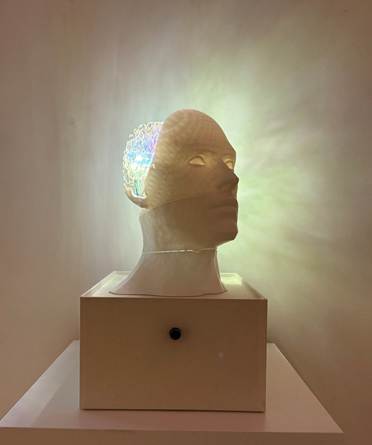
Dialectics of the Mind is my thesis-adjacent art installation, created for the Pulse Art and Technology Exhibition 2026 at Telfair Museum. I’m an MFA Interactive/Game Design student with a background in literature: my work sits at the intersection of cognition, emerging technology, and human experience.
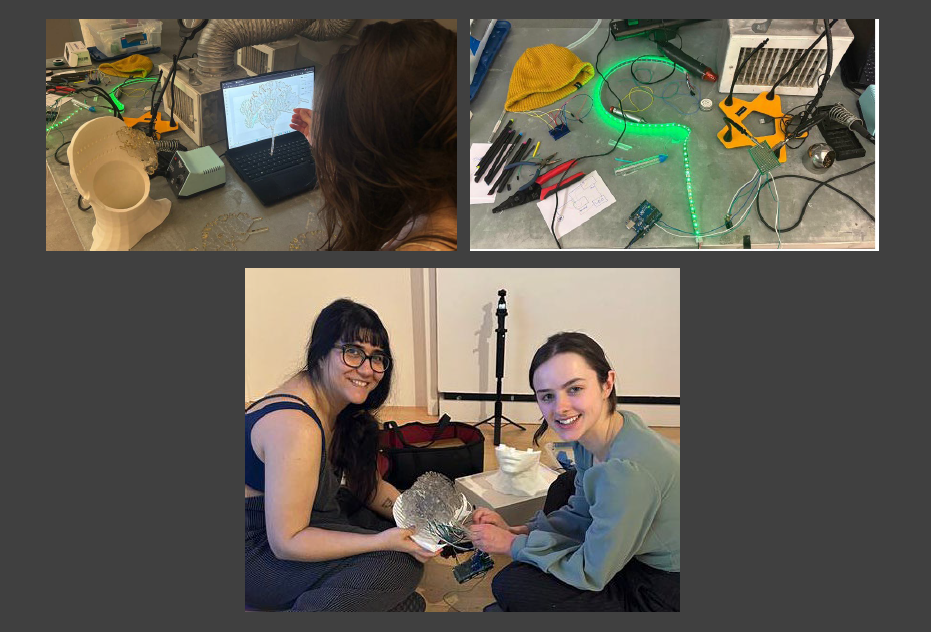
Lauren Peterson, an MFA Industrial Design student, collaborated with me on the physical fabrication: the 3D-printed bust and the spatial layout of the piece. Working with her on this was genuinely fun!
02: CONCEPT
The Idea: Where It Began
As a creative, I’m always looking for new ways to express myself, leveraging technology to shape ideas into something real. Through that process I’ve spent a lot of time with AI, using it, playing with it, building with it. But there’s always been this question sitting in the back of my mind: is AI reshaping the way I make decisions?
It has to be. A poster on your wall changes how you see the room after a while, so an AI you talk to every day is doing something to your thoughts too. The question is whether it stops there, or goes deeper than that.
That’s what sent me into the literature: cognitive liberty, psychologically safe AI, EEG band powers, the porous line between observation and influence.
Core Question
“Are we mindful of our cognitive liberty as AI shapes our inner world?”
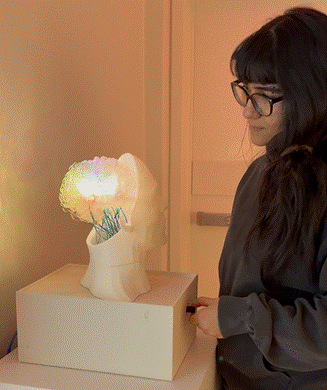
The installation invites visitors not to answer, but to sit in the uncertainty, to observe their own cognitive state as an external force (the dial, the light, the pulse) appears to modulate it.
03: RESEARCH
Literature Reviews
I didn’t approach these papers as citations. I used them as lenses. Each one reframed the central question from a different angle and pushed the work somewhere new.
Binz & Schulz (2023): Turning Large Language Models into Cognitive Models
What struck me here was the idea that an LLM, fine-tuned on psychological experiment data, could predict human choices more accurately than existing cognitive models. That’s not just a technical achievement: it collapses the boundary between observation and influence. If a system knows what you’ll do before you do, is it still just watching?
Jiang, Wu & Leung (2025): Cognitive Impacts of LLM Interactions on Problem Solving and Decision Making Using EEG Analysis
This one was directly tied to the technical core of the piece. It confirmed that LLM interactions measurably modulate brain activity: reducing frontal theta power, increasing P300 amplitude. The influence isn’t abstract. It shows up in the signal. That’s what I was trying to make visible.
Talboy & Fuller (2023): Cognitive Bias in LLMs and Best Practices for Workplace Adoption
This is where I got further familiar with the risk that AI subtly reshapes human thought patterns, mirroring, reinforcing, and in some cases distorting the cognitive biases of the people it’s trained on. It gave language to the anxiety the whole piece is built around.
Farahany, N. A. (2023): The Battle for Your Brain
The legal and ethical backbone of the work. Farahany argues that mental privacy and cognitive self-determination are the defining civil rights challenges of the coming decades. Reading this, the piece stopped feeling like an art project and started feeling urgent.
04: IDEATION
Sketches & Design Thinking
Finding the Right Interaction
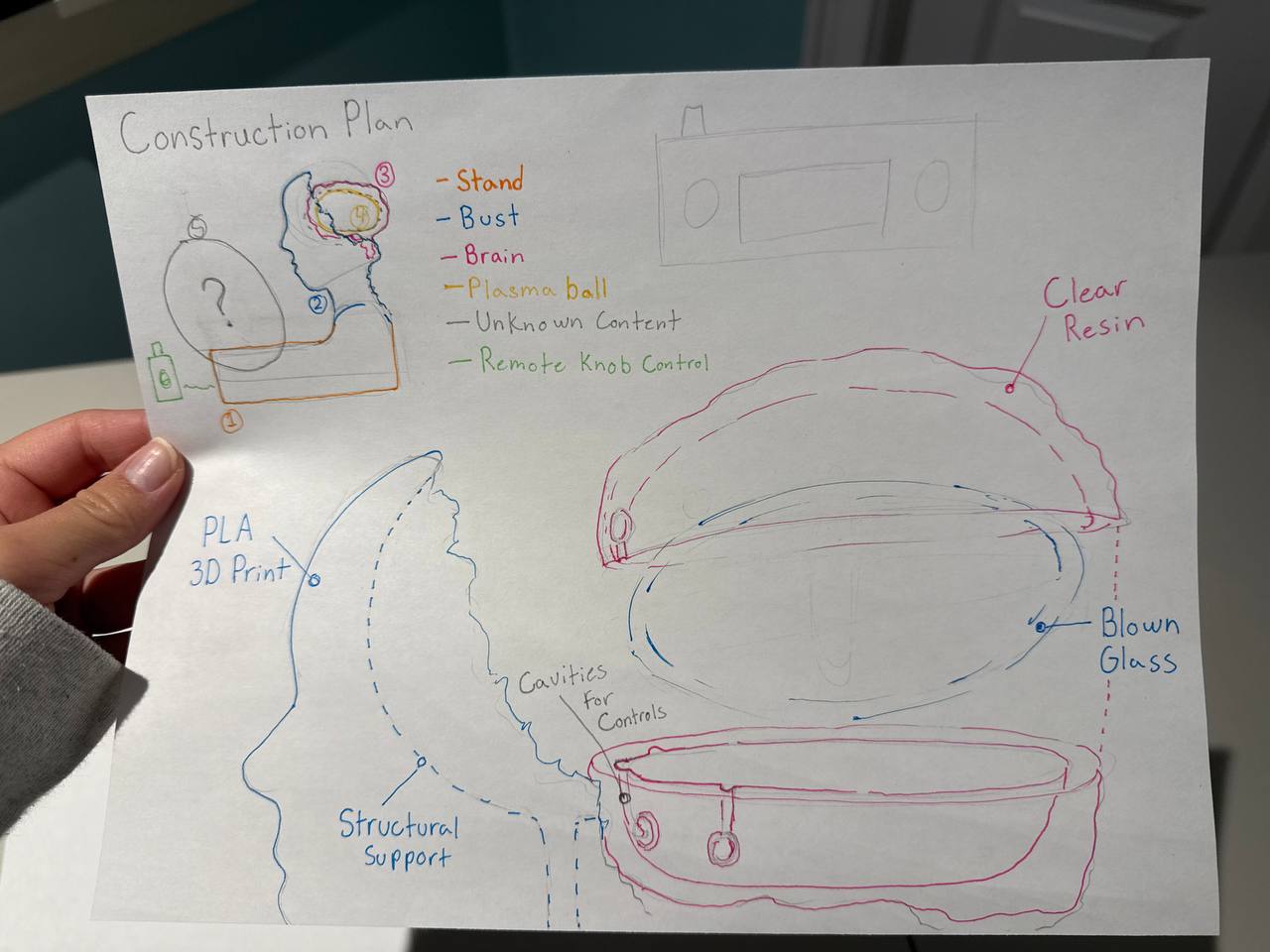
The challenge was to create a point of interaction that was inviting and playful, not clinical or intimidating. Sensors felt too passive; touchscreens felt too digital. The dial emerged as the perfect metaphor: an analog interface that looks almost like a toy, yet implies control over something intimate and complex.
The dial puts the visitor in an observational mode. They are not ‘playing’ the brain. They are watching what happens when they intervene. The colors, pulse speed, and light intensity respond nonlinearly, mirroring how AI models compute through nonlinear neural pathways.
Design Goals
Experimentation over explanation. The piece should raise questions, not answer them. Visitors should leave unsure whether they were controlling the brain or being controlled by it.
05: FABRICATION
Making the Piece
3D-Printed Bust
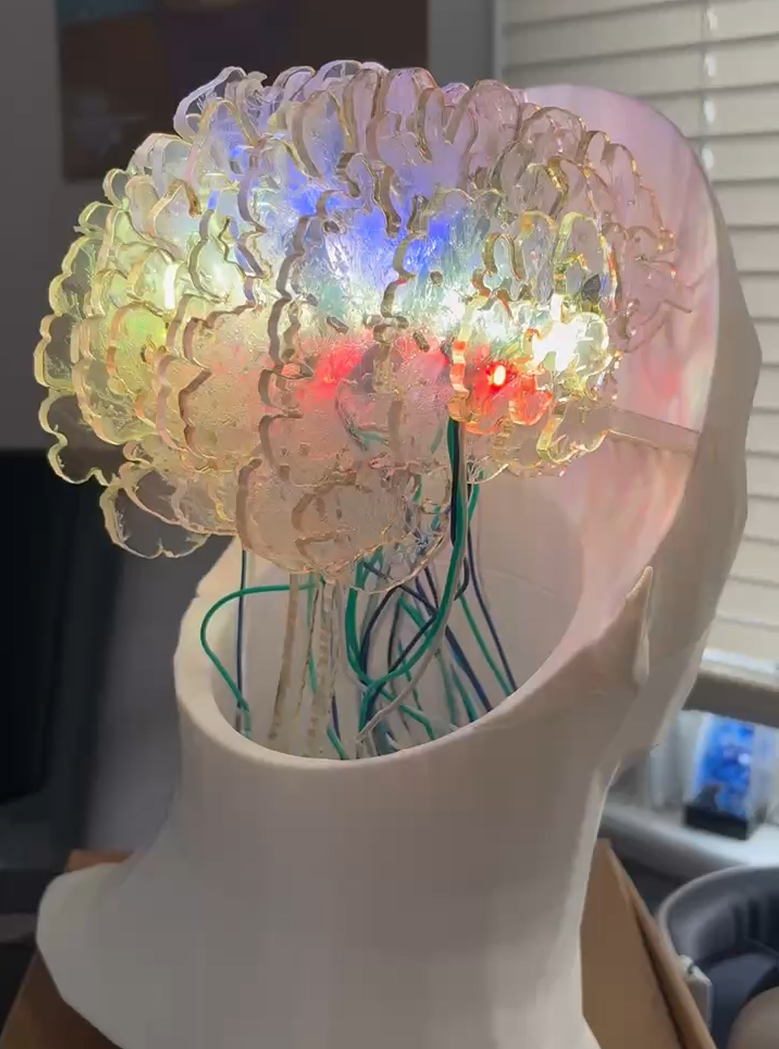
The human bust was 3D-printed in white PLA, a collaboration with Lauren Peterson, who brought her industrial design precision to the fabrication. The form references classical sculpture: a head without identity, universal and anonymous. The brain cavity was hollowed out to house the acrylic panels and NeoPixel LED strips, allowing light to glow through the semi-translucent print from within.
Layered Acrylic Panels
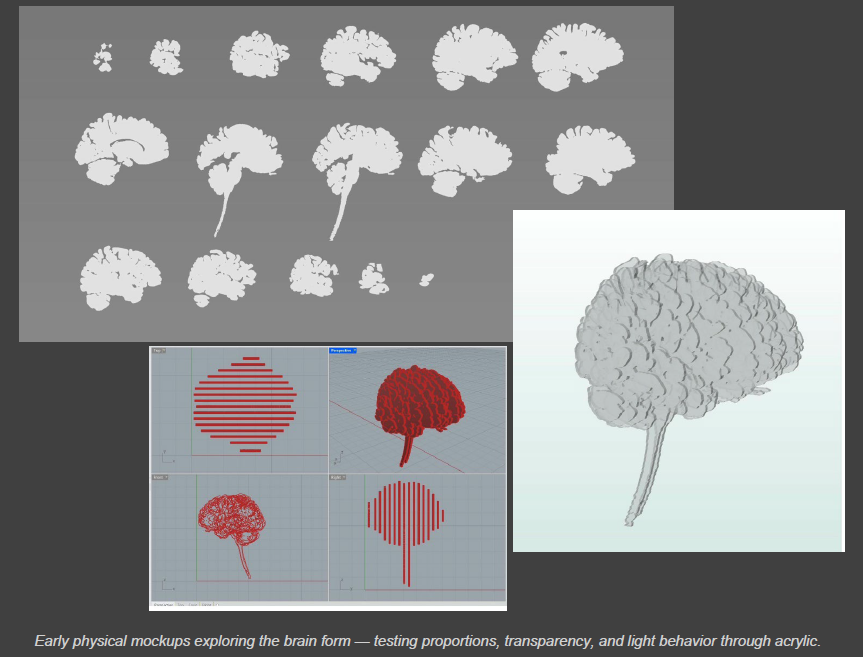
Multiple layers of engraved acrylic were stacked inside the brain cavity. The engravings represent different brain regions and neural pathways, a decision rooted in the EEG band research. When illuminated from below, the layers create depth and texture: the brain appears to have internal structure, to breathe, to think.
06: ELECTRONICS & CODE
Arduino: Brain Pulse System
Hardware
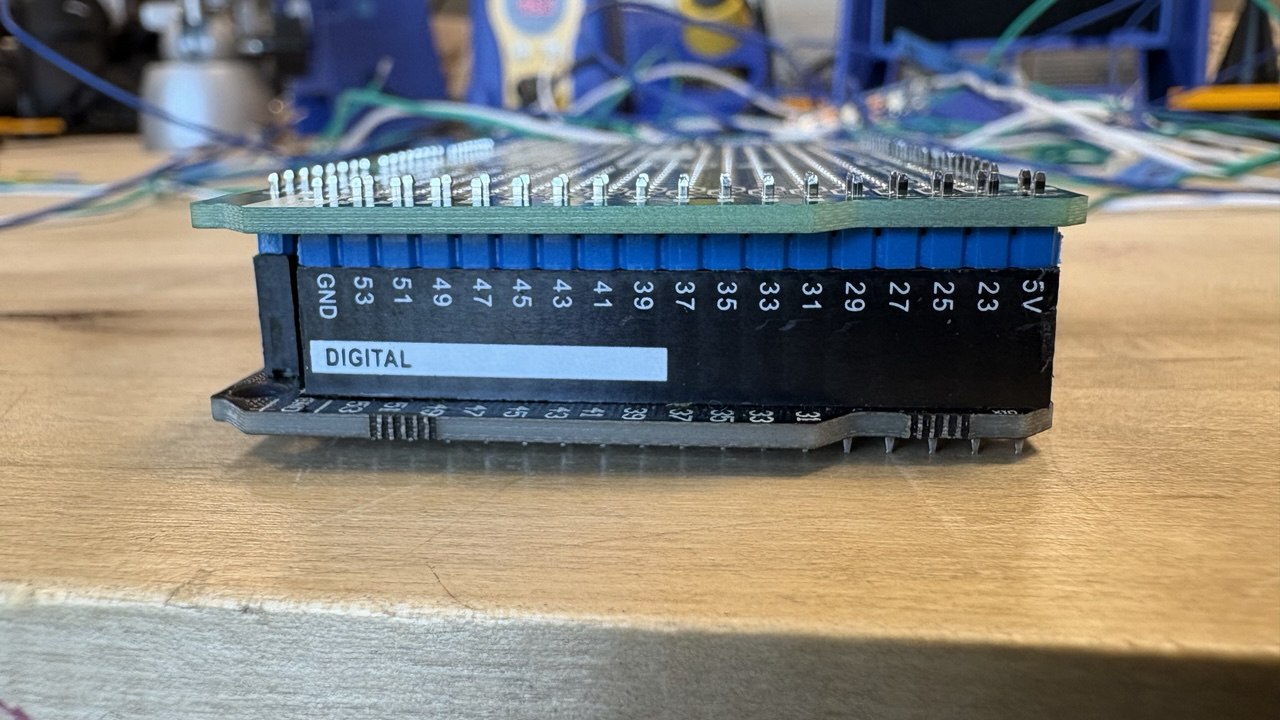
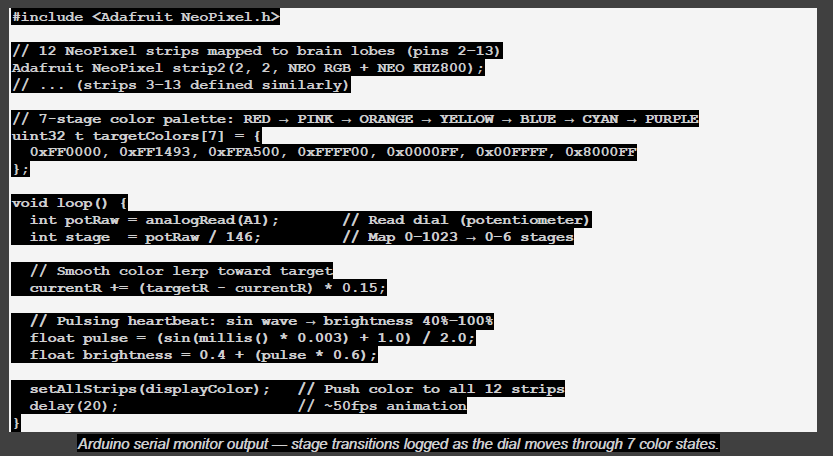
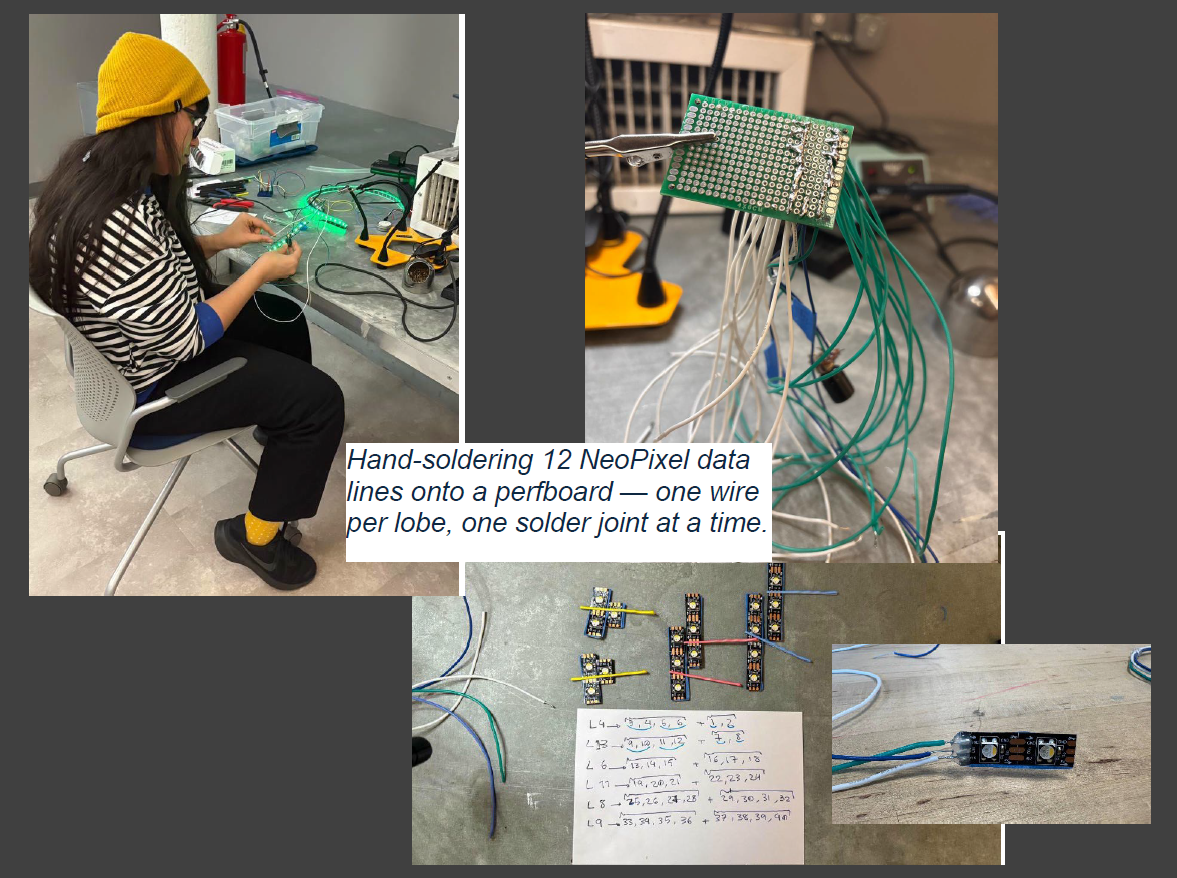
The piece runs on an Arduino Mega with a proto shield, driving twelve NeoPixel strips, each one mapped to a different region of the acrylic brain. A single potentiometer is the only input: as the visitor turns the dial, it moves through seven color states from red to purple, with smooth transitions so the shift feels like a mood changing rather than a switch flipping.
The brain also pulses on its own: a sinusoidal brightness wave running at ~50fps, independent of anything the visitor does. That autonomy was intentional. The brain isn’t just responding to you. It has its own rhythm.
06B: EARLIER PROTOTYPE
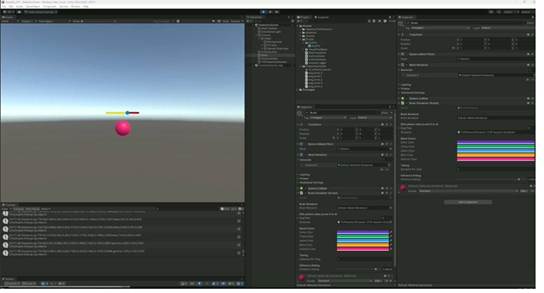
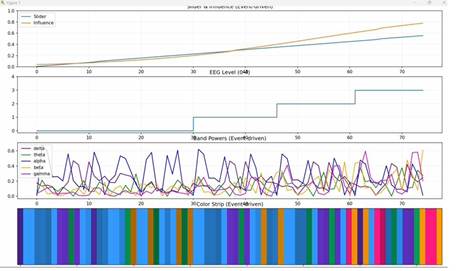
Before committing to the physical build, I prototyped the core idea in Unity. I wanted to know if real EEG data, pulled directly from the literature, could drive a visual response that actually felt meaningful. So I wired the dial into Unity over serial, loaded CSV brainwave data across five cognitive states (Level 0 = cognitive liberty, Level 4 = high AI influence), and built a live dashboard in Python to watch it all in real time.
It worked. The dominant brainwave band at each moment determined the color, the amplitude shaped the brightness, and the whole thing streamed as JSON so I could see exactly what was happening inside the interaction. That confirmed the thesis was worth building physically.
07: EXHIBITION DAY
Pulse Art and Technology Exhibition 2026
The Piece in the Space
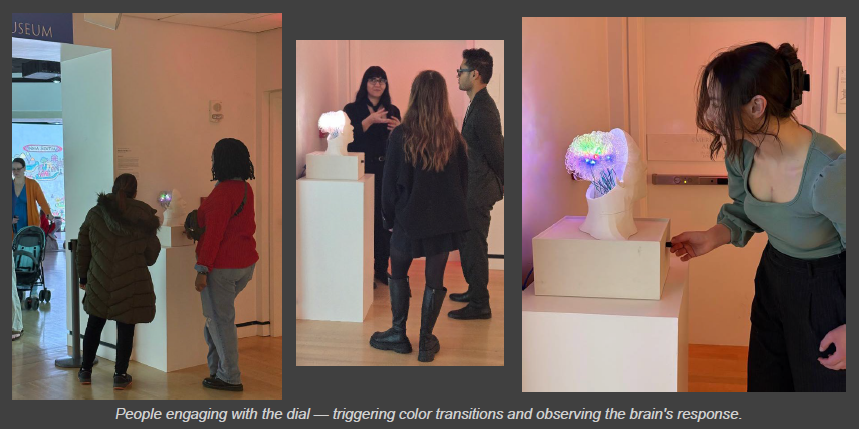
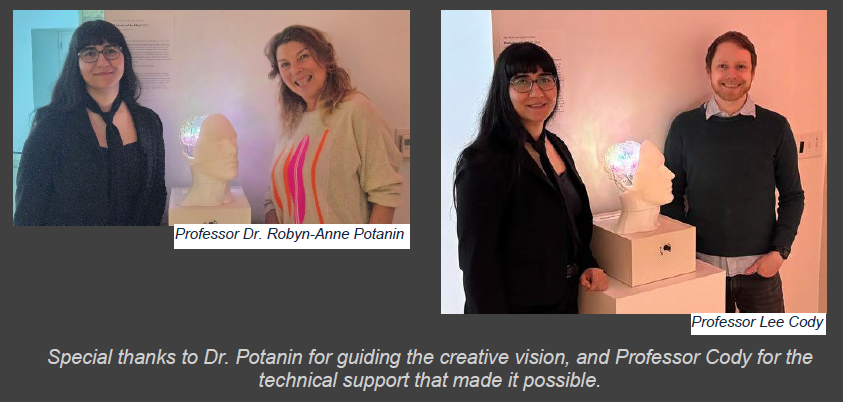
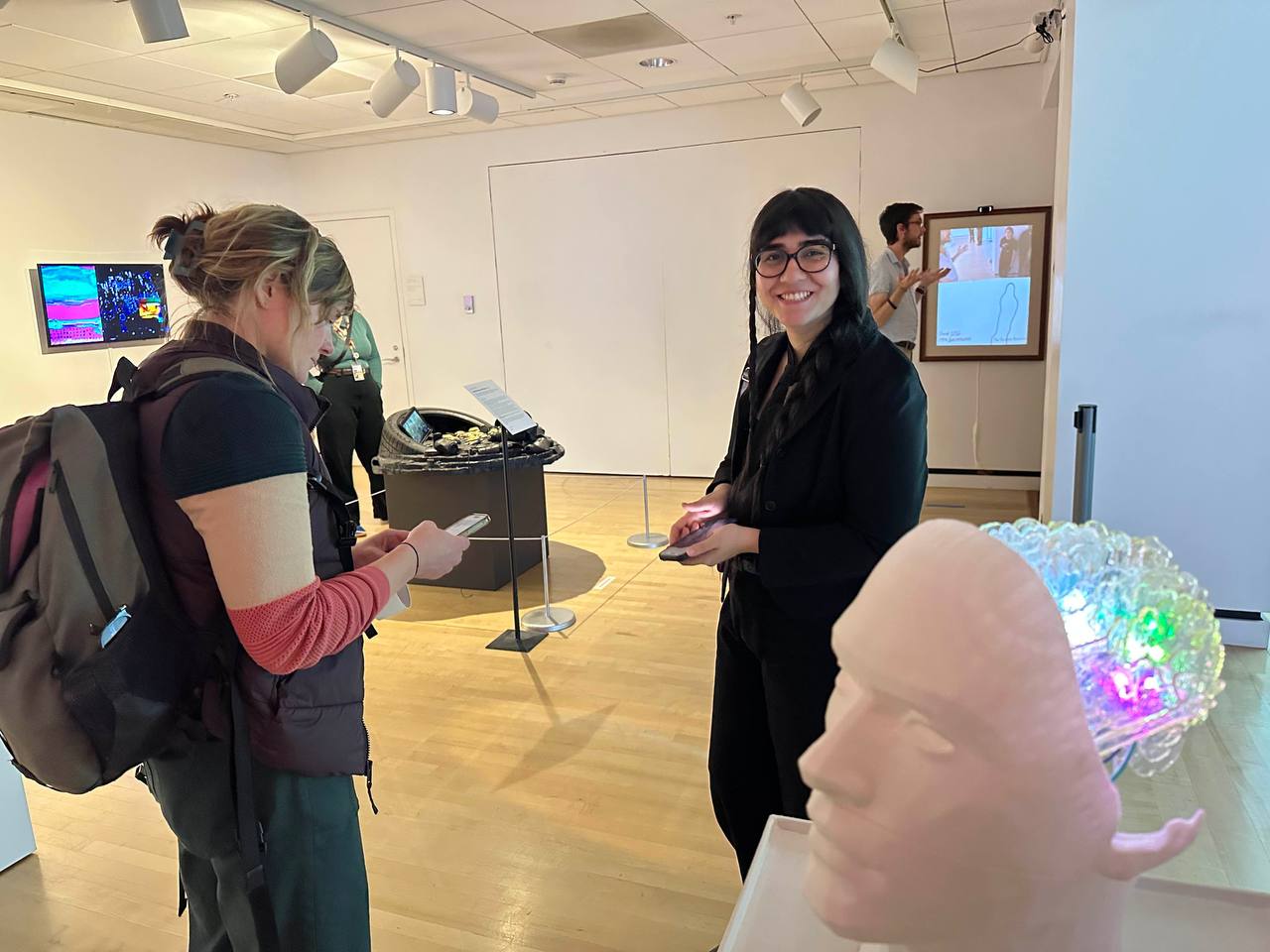
The installation was shown at the Pulse Art and Technology Exhibition 2026 at Telfair Museum. The piece occupied a corner position with soft ambient lighting: the pulsing brain glow was visible from across the gallery. Visitors of all backgrounds interacted with it: some turned the dial slowly and deliberately, others spun it quickly to watch the colors chase each other. Both responses felt exactly right.
08, REFLECTIONS
What Worked
The dial was the right choice. It created exactly the observational mode I was after. The smooth color transitions made the piece feel alive in a way that an abrupt state change never could have.
What I’d Push Further
I want to extend the piece beyond a single exhibition: integrating real-time EEG data so the brain responds to the visitor’s actual cognitive state, not a simulated one. That’s when the question stops being hypothetical.
Closing Thought
The brain pulses whether you touch it or not. The question is whether you’re paying attention to your own.
09: Recognition
The Body Electric, Telfair Museums, Savannah
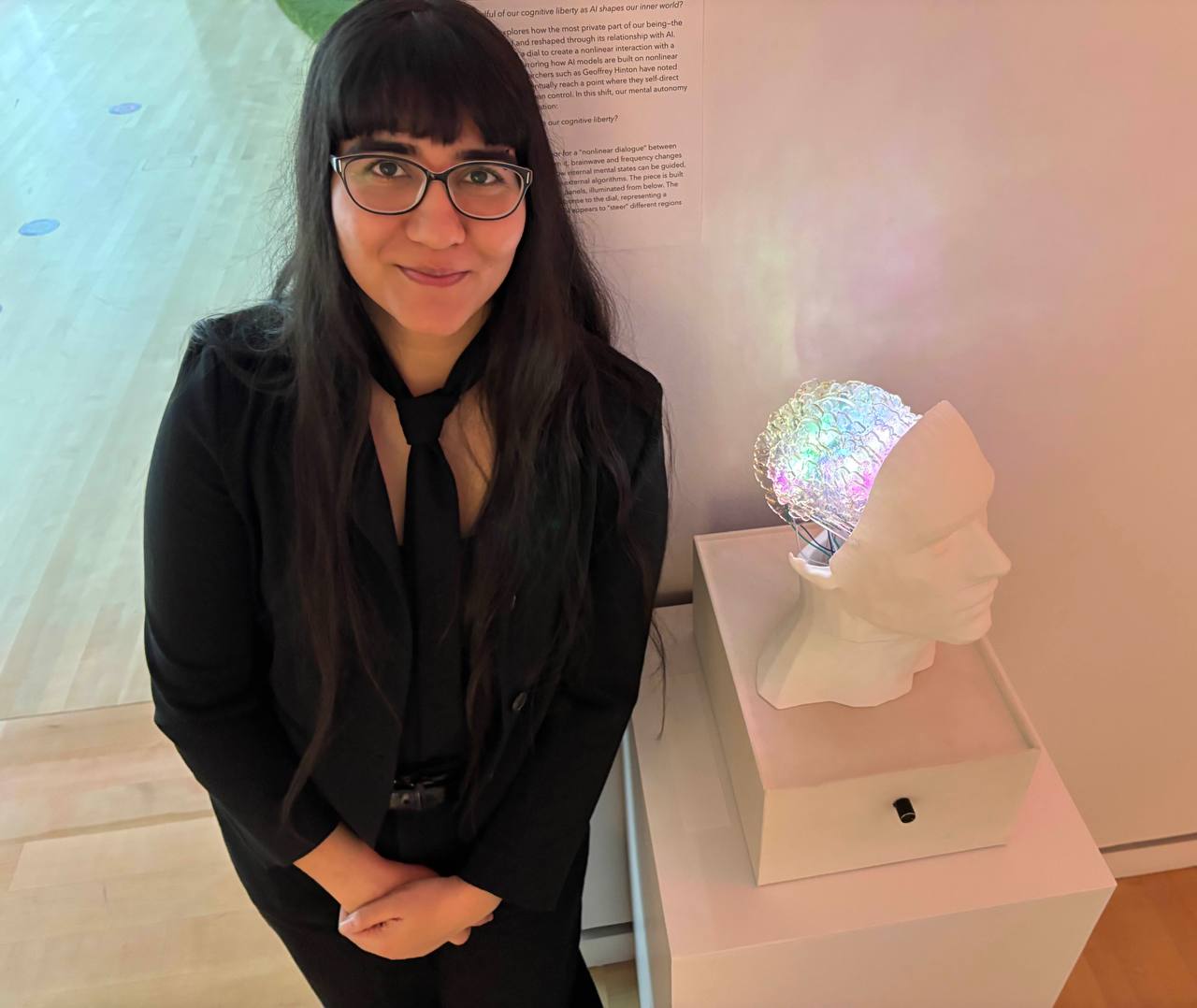
Dialectics of the Mind was selected for The Body Electric, a PULSE Local Projects exhibition presented by Telfair Museums (January 22 – February 16, 2026), a showcase of Savannah-based artists working with video, AI, and interactivity. The exhibition was covered by WTOC, Savannah CEO, and Grice Connect, and was part of the 19th annual Pulse Art and Technology Festival.
The festival drew over 1,000 visitors across the two main days, and 2,000 in a single day during Super Museum Sunday, with thousands of people encountering the piece over the course of the run.
After the close of the exhibition, Harry DeLorme from Telfair reached out directly:
“We really enjoyed having your work on view and literally thousands of people saw it.”
https://www.telfair.org/event/pulse26/
https://www.wtoc.com/2026/01/20/telfair-museum-hosts-pulse-art-technology-festival/
https://arxiv.org/abs/2306.03917
https://arxiv.org/abs/2304.01358
https://www.nitafarahany.com/the-battle-for-your-brain
First published on Substack.